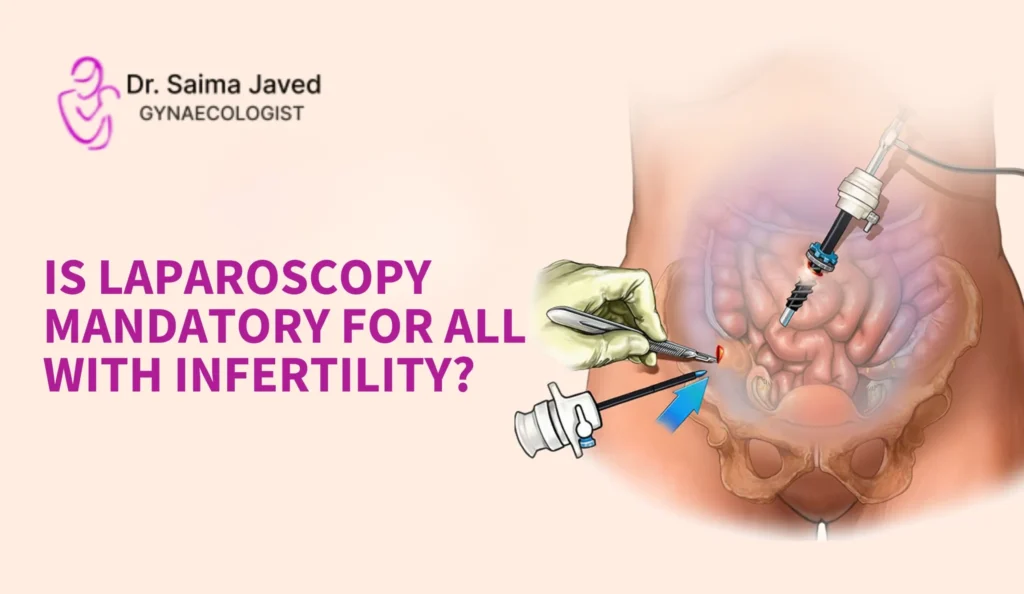
Is Laparoscopy Mandatory for All with Infertility?

Home / Blog / Is Laparoscopy Mandatory for All with Infertility?

Is Laparoscopy Mandatory for All with Infertility?

By Admin

|     25.03.2024

Hello Reader!

Welcome to the blog page of Dr. Saima Javed, one of the best lady gynecologist in Kolkata.

When a couple struggles to conceive, the first question that often arises during medical consultations is whether laparoscopy is required. As the best lady gynecologist in Kolkata, Dr. Saima Javed believes in helping patients understand the role of laparoscopy in infertility — when it is necessary, when it’s optional, and how it can contribute to successful conception.

Let’s explore this topic in detail and answer the common concern: “Is laparoscopy mandatory for all with infertility?”

best lady gynecologist in Kolkata, Best gynecologist In Kolkata, Best lady gynecologist In Kolkata, gynecologist In Kolkata, Lady gynecologist In Kolkata, Is Laparoscopy Mandatory

Understanding Laparoscopy in Infertility

Laparoscopy is a minimally invasive surgical procedure that allows doctors to view the pelvic organs — including the uterus, fallopian tubes, and ovaries — through a small incision. It helps detect hidden causes of infertility such as endometriosis, fibroids, adhesions, or blocked tubes.

However, is laparoscopy mandatory for everyone dealing with infertility?
The short answer is — no, not always. The decision depends on each patient’s medical history, symptoms, and prior test results.

As the best lady gynecologist in Kolkata, Dr. Saima Javed explains that laparoscopy is usually suggested when non-invasive tests do not give a complete picture or when specific problems are suspected.

Laparoscopy is generally recommended in the following situations:

  1. Suspected Endometriosis:
    When patients experience severe pelvic pain, painful periods, or unexplained infertility, laparoscopy helps confirm and treat endometriosis.
  2. Tubal Blockage:
    If an HSG (Hysterosalpingogram) report shows blockage in the fallopian tubes, laparoscopy can diagnose the exact location and extent of the blockage.
  3. Pelvic Adhesions or Fibroids:
    Sometimes, scar tissue or fibroids prevent fertilization. Laparoscopy helps locate and remove these obstacles.
  4. Ovarian Cysts or Structural Abnormalities:
    If ultrasound scans reveal cysts or irregularities, laparoscopy helps both diagnose and treat them simultaneously.

Thus, while laparoscopy is a powerful tool in reproductive medicine, the question “is laparoscopy mandatory” can only be answered after evaluating individual clinical findings.

When Laparoscopy May Not Be Necessary

Not every infertility case requires surgical intervention.
For example:

  • Hormonal Imbalance: If infertility is due to thyroid dysfunction, PCOS, or irregular ovulation, medical management or lifestyle changes are usually the first approach.
  • Male Factor Infertility: If semen analysis shows low sperm count or poor motility, laparoscopy may not offer any benefit.
  • Early Stages of Infertility: For couples who have been trying for less than a year and show no alarming signs, basic fertility tests are done before considering laparoscopy.

Dr. Saima Javed, the best lady gynecologist in Kolkata, emphasizes that diagnostic laparoscopy is never a “must” for every case. The goal is always to use the least invasive and most effective method to help couples conceive safely.

Advantages of Laparoscopy When Indicated

Even though laparoscopy is not mandatory for all, it offers several benefits when required:

Accurate Diagnosis: Provides a clear view of reproductive organs and detects problems that imaging may miss.
Simultaneous Treatment: Issues like cysts, adhesions, or endometriosis can often be treated during the same procedure.
Faster Recovery: As a minimally invasive procedure, recovery time is short, and hospital stays are minimal.
Improved Pregnancy Chances: Treating underlying issues increases the chances of natural conception or success in assisted reproductive techniques like IVF.

These benefits explain why the best lady gynecologist in Kolkata, Dr. Saima Javed, recommends laparoscopy selectively — when it truly adds value to a couple’s fertility journey.

Alternative Investigations Before Laparoscopy

Before deciding on laparoscopy, several non-invasive tests are usually performed, such as:

  • Pelvic ultrasound
  • Hormonal evaluation
  • Semen analysis for the partner
  • HSG (for tubal assessment)

If these tests reveal no abnormalities, and there are no symptoms suggesting pelvic disease, then laparoscopy might not be immediately necessary. The decision depends on a personalized fertility plan tailored by your gynecologist.

Expert Advice from Dr. Saima Javed

As the best lady gynecologist in Kolkata, Dr. Saima Javed believes that every patient deserves an individualized approach. The question “is laparoscopy mandatory” should never be answered with a simple “yes” or “no” — it depends entirely on the cause of infertility, test results, and patient comfort.

Laparoscopy is a diagnostic and therapeutic tool — not a routine test for everyone. With proper evaluation, many couples can achieve pregnancy through medication, timed intercourse, or minimally invasive fertility treatments before considering surgical options.

Also Read: Can a Laparoscopy Help Operate on an Ovarian Cyst?
best lady gynecologist in Kolkata, Best gynecologist In Kolkata, Best lady gynecologist In Kolkata, gynecologist In Kolkata, Lady gynecologist In Kolkata, Is Laparoscopy Mandatory

Laparoscopy is recommended versus skipped in infertility based on specific clinical indications and findings from initial diagnostic tests.

  • When a woman experiences chronic pelvic pain, painful periods, or painful intercourse, suggesting possible endometriosis, laparoscopy can both diagnose and treat the condition effectively.
  • If imaging studies like ultrasound or HSG show abnormalities such as blocked fallopian tubes, cysts, fibroids, or pelvic masses, laparoscopy helps confirm and treat these issues.
  • In cases of unexplained infertility—where ovulation, semen analysis, and imaging appear normal but conception does not occur after 6 to 12 months—laparoscopy can detect hidden factors like mild endometriosis or adhesions.
  • After multiple failed cycles of fertility medications or intrauterine insemination (IUI), laparoscopy may be advised to reassess and optimize reproductive anatomy before IVF.
  • Laparoscopy allows for direct visualization and dye testing of reproductive organs, which is superior to other tests in identifying tubal blockages and pelvic pathologies.

When Is It Skipped?

  • If the infertility cause is clearly identified such as male factor infertility or hormonal disorders like PCOS or thyroid dysfunction, laparoscopy might not be necessary.
  • When imaging and non-surgical tests are normal and there are no symptoms like pain or prior pelvic infections, doctors may initially choose non-invasive treatments and follow up with assisted reproduction techniques directly.
  • Laparoscopy is also generally skipped if a woman plans to proceed directly to IVF since IVF bypasses anatomical causes of infertility.
  • The procedure may be avoided if risks from surgery outweigh potential benefits or if non-invasive methods adequately explain infertility.

Laparoscopy is a powerful tool but is recommended selectively by the best lady gynecologist in Kolkata after thorough clinical evaluation. It is not a mandatory procedure for all infertility cases but is crucial in specific scenarios for diagnosis and treatment, balancing benefits against its invasiveness and costs.
best lady gynecologist in Kolkata, Best gynecologist In Kolkata, Best lady gynecologist In Kolkata, gynecologist In Kolkata, Lady gynecologist In Kolkata, Is Laparoscopy Mandatory

Risks and recovery time after diagnostic laparoscopy

Diagnostic laparoscopy carries some risks, but it is generally considered a safe and minimally invasive procedure. Possible risks include:

  • Damage to internal organs such as the bladder, bowel, or blood vessels
  • Bleeding or infection at the incision sites
  • Allergic reactions to anesthesia
  • Formation of blood clots (DVT or pulmonary embolism)
  • Hernia at the incision site
  • Rarely, need to convert to open surgery if complications arise

Recovery time from diagnostic laparoscopy is typically shorter and quicker compared to open surgery. Most patients:

  • Can expect mild pain or discomfort at incision sites lasting a few days
  • May experience transient shoulder pain caused by the gas used to inflate the abdomen, which usually resolves promptly
  • Usually return to normal, non-strenuous activities within 1 to 2 weeks
  • Are often able to resume light work within about a week
  • Should avoid heavy lifting, strenuous exercise, baths, and driving for a few days as advised by their doctor
  • Should watch for signs of complications such as fever, increasing pain, redness, swelling, or difficulty urinating and consult their physician if these occur

Proper post-operative care, including pain management with analgesics, hydration, gentle mobilization, and wound care, supports faster recovery and reduces complications.

As the best lady gynecologist in Kolkata, these risks and recovery expectations are communicated clearly to patients to ensure a safe and comfortable experience with diagnostic laparoscopy.

best lady gynecologist in Kolkata, Best gynecologist In Kolkata, Best lady gynecologist In Kolkata, gynecologist In Kolkata, Lady gynecologist In Kolkata, Is Laparoscopy Mandatory

What warning signs need urgent medical attention after laparoscopy?

After a laparoscopy, it is important to be vigilant for certain warning signs that may indicate complications requiring urgent medical attention. Some of the key signs to watch for include:

  • Severe abdominal pain that does not improve or worsens over time.​
  • Persistent fever above 101°F (38.5°C), especially if it lasts more than a day or two, which may suggest infection.​
  • Redness, swelling, warmth, or pus around the incision sites, indicating possible wound infection.​
  • Unusual or heavy bleeding from the incision or vaginal bleeding that is more than normal.​
  • Difficulty breathing, chest pain, or coughing up blood, could be signs of a pulmonary embolism or other respiratory issues.​
  • Severe shoulder tip pain that persists or worsens, possibly from diaphragmatic irritation, but if severe and unrelenting, seek urgent care.​
  • Signs of deep vein thrombosis (DVT) such as swollen, hot, and painful legs.​

If any of these warning signs appear, it is crucial to seek immediate medical attention—either contact your healthcare provider promptly or visit the emergency department, especially in cases of chest pain, difficulty breathing, or significant bleeding.​

Monitoring your recovery closely and being aware of these warning signs helps ensure prompt management if complications develop, leading to safer and smoother recovery after laparoscopy.

best lady gynecologist in Kolkata, Best gynecologist In Kolkata, Best lady gynecologist In Kolkata, gynecologist In Kolkata, Lady gynecologist In Kolkata, Is Laparoscopy Mandatory

How to recognise wound infection versus normal healing after laparoscopy?

Wound infection after laparoscopy can be distinguished from normal healing by carefully observing certain signs and symptoms around the incision site.

Signs of Normal Healing

  • Mild redness and swelling around the incision are expected in the first few days as part of normal inflammation.
  • The wound gradually scabs over and pink or red granulation tissue develops underneath, which is a healthy phase of healing.
  • Mild warmth and slight tenderness near the incision improve progressively.
  • Minimal clear or slightly yellowish drainage may be normal initially.
  • Pain around the site decreases steadily over days.

Signs of Wound Infection

  • Increasing or worsening redness and swelling around the incision, especially redness that spreads beyond the immediate area.
  • The skin around the wound feels hot to the touch and the area is more tender or painful than before.
  • Discharge of cloudy, yellow, green, or foul-smelling pus from the wound.
  • The wound edges do not close, or the incision appears to be opening or breaking down.
  • Development of red streaks spreading from the incision (sign of lymphangitis).
  • Persistent or high fever, chills, and feeling generally unwell alongside local symptoms.
  • Excessive pain that worsens instead of improving.

If any signs of infection are noticed, urgent medical consultation is necessary to avoid complications like deep infection or sepsis. The best lady gynecologist in Kolkata advises patients to monitor their surgical sites closely and report any abnormal changes promptly to ensure effective treatment.

best lady gynecologist in Kolkata, Best gynecologist In Kolkata, Best lady gynecologist In Kolkata, gynecologist In Kolkata, Lady gynecologist In Kolkata, Is Laparoscopy Mandatory

FAQ

1. Is laparoscopy mandatory for all women facing infertility?

No, laparoscopy is not mandatory for everyone. It’s usually recommended when other fertility tests, like an ultrasound or hormone analysis, don’t reveal the cause of infertility.

2. When does a gynecologist suggest laparoscopy for infertility?

Laparoscopy is advised when conditions like endometriosis, fibroids, blocked fallopian tubes, or pelvic adhesions are suspected.

3. Can infertility be treated without laparoscopy?

Yes, many infertility cases can be treated through medications, hormonal therapy, or assisted reproductive techniques like IUI and IVF, depending on the cause.

4. What are the benefits of laparoscopy in infertility evaluation?

Laparoscopy provides a clear view of the pelvic organs and can help diagnose and treat hidden problems that might not be visible in other tests.

5. Is laparoscopy a safe procedure for infertility patients?

Yes, it is a minimally invasive and generally safe procedure when performed by an experienced gynecologist. Recovery is quick, and complications are rare.

Conclusion

To sum up, is laparoscopy mandatory for all with infertility?
No, it’s not.

Laparoscopy is an effective and safe procedure, but it should only be recommended when necessary. Many infertility cases can be managed with non-surgical treatments, depending on the underlying cause.

If you and your partner are facing challenges in conceiving, consult Dr. Saima Javed, the best lady gynecologist in Kolkata, for a detailed evaluation and customized fertility plan. With the right diagnosis and compassionate guidance, your journey toward parenthood can be smoother and more hopeful.


Need to see a gynaecologist?

We’ve made it simple for you to schedule an appointment right
away via Whatsapp.

Share This Article

Recent Post